
Advertising on Meta platforms has reached a turning point. Between algorithm upgrades, privacy changes, and AI‑driven delivery systems, the only constant in digital marketing is adaptation. Meta’s latest design — Meta Andromeda — isn’t just another update. It fundamentally restructures how ads are delivered, how creative is interpreted, and how success is measured.
For years, advertisers relied on audience controls such as interests, lookalikes, and detailed segmentation to drive results. That playbook is quickly changing. With the expansion of Advantage+ automation and the rollout of Andromeda, Meta is moving away from micro-managing audiences toward a model driven by machine learning and creative intelligence.
In this post, I’ll break down what Meta Andromeda is, why it requires a shift in strategy, what advertisers need to do to succeed in this changing environment, and how creatives, automation, and improved monitoring fit into the new ecosystem.
You might also be interested in some of our other posts, including: Digital Marketing Trends: What to Expect in 2025, How to Engage Your Audience in a Saturated Social Media Environment
What Is Meta Andromeda
When Meta introduced Andromeda, they didn’t simply rename an algorithm. What was released is a new retrieval‑centered engine that changes how ads are matched to people across Facebook, Instagram, and Meta’s other platforms.
Meta created Andromeda because the sheer volume and variety of ads had grown so large that the older system couldn’t manage them efficiently. The older ad delivery system struggled to keep up with this growth, slowing decision-making and reducing accuracy. Meta needed a way to scan far more ad options for each user in milliseconds while maintaining precision. This new setup allows Meta to use larger models and specialized hardware to match more relevant ads to each person.
To understand its impact on advertising, we first need to understand how it differs from the traditional delivery logic.
Old Delivery Logic
Previously, Meta’s delivery system used segmentation and ranking. Advertisers created audiences — based on interests, behaviors, demographics, and lookalikes — and then ranked ads within those segments based on bid, relevance, and predicted action. This model prioritized who the ad was shown to. Campaign success was heavily dependent on audience construction and micro‑targeting.
Andromeda’s New Logic
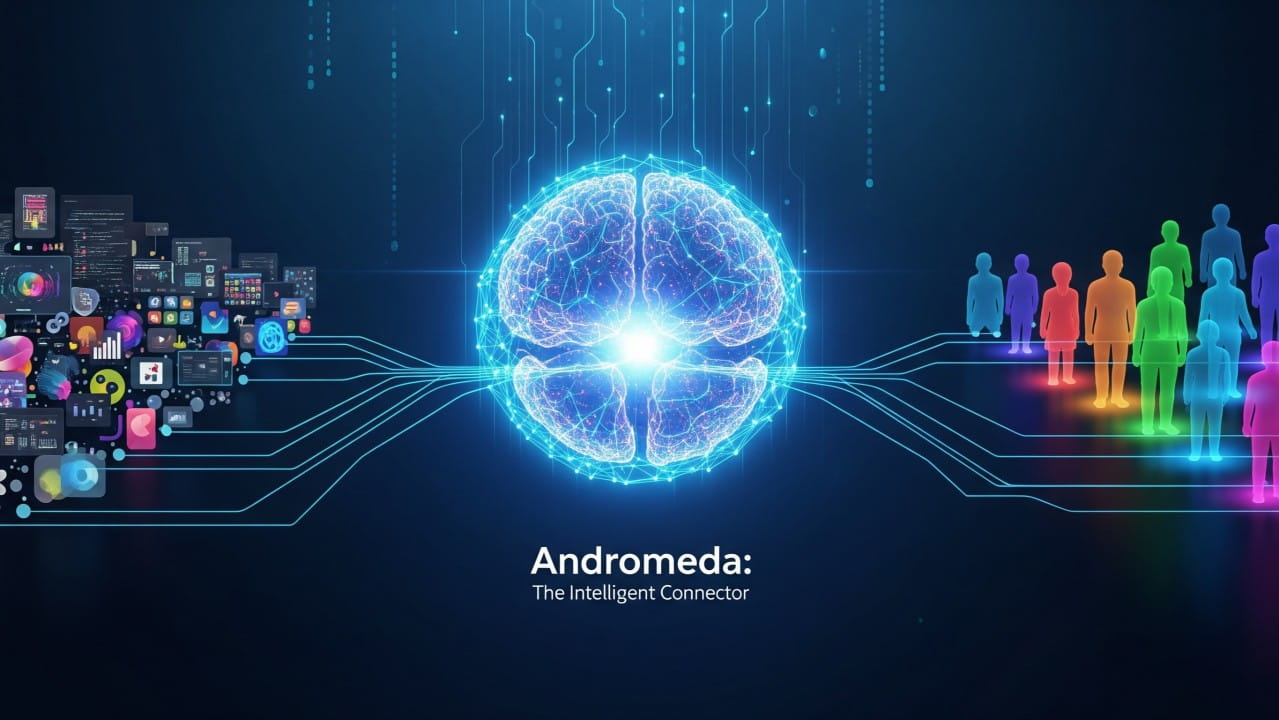
Meta Andromeda incorporates advanced machine learning models that prioritize retrieval over ranking. Instead of isolating audience segments and ranking ads within them, Andromeda scans a far broader set of signals to determine the most relevant creative for each individual user in real time.
It leverages:
- behavioral patterns and engagement history
- creative attributes like messaging structure and format
- cross‑platform interaction signals
- conversion signals, including Pixel and server‑side (CAPI) data
- contextual cues such as placement, device type, and time of day
This doesn’t mean audiences no longer matter; it means the system has shifted to a signal‑centric approach where relevance is evaluated more holistically than before.
Rather than asking “which audience should I target?”, Andromeda operates more like “which message is most relevant to each person’s intent right now?”. Meta Andromeda leans less on the recent engagement and more on “knowing you”. Andromeda is supposed to move beyond broad categories (“you like shoes”) and toward finer personalization (“you like these shoes in this context”). It’s a fundamentally different approach to personalization. One that relies heavily on what you create, not just who you select.
Shift to Creative Strategy
If Andromeda’s core innovation is in how it interprets signals, then creativity becomes the central performance factor. Audiences matter, but the way creative communicates with users now carries more weight than micro‑segmented targeting.
In previous delivery models, campaigns were often scaled by manipulating audiences — expanding lookalikes, layering interests, adding exclusions, creating audience overlaps to squeeze additional performance. Creative innovation was important, but many marketers treated it as a secondary input to targeting logic.
Under Meta Andromeda, the priority flips: creative is now a primary input that drives signal learning and delivery effectiveness. Your job is no longer to manually identify and segment audiences; it’s to supply enough creative diversity that Andromeda can personalize delivery at scale.
A campaign with one strong creative and 47 audience segments will underperform against a campaign with 30 varied creatives and broad targeting. The complexity has shifted from structure to content.
What This Means in Practice
Rather than small variations that change only color, CTA wording, or background, Andromeda rewards conceptually distinct creative angles — variations that speak to different user motivations or context.
Think about it this way: If you only provide a single product demo video, Meta can only try that one angle. But if you create ads that lean into different pain points and customer personas, the system can learn which ones respond and deliver ads that feel more personal.
Examples of creative differentiation that work well include:
- Problem‑Solution Narrative – Addresses a core user pain point and positions the product/service as the solution.
- Testimonial / Social Proof – Uses real user voices or endorsements to build trust with skeptical audiences.
- Benefit‑Driven Direct Response – Highlights a quantifiable value (e.g., savings, time — “Save 30% today”).
- Educational / Value‑First Content – Teaches something useful first, and only then introduces the product.
- Lifestyle / Aspirational Formats – Shows deeper emotional or identity alignment, often effective for higher‑intent users.
Andromeda interprets these creative signals and matches them with user behavior patterns, not just audience parameters. Over time, it learns which creative type resonates with which intent — whether that’s curiosity, research, affinity, or transaction‑ready behavior.
Quick Tip:
Instead of producing 10 slight variations of the same idea, focus on 3–5 completely different angles. Each angle should target a different slice of user intent — and each should have 2–4 format variations.
What We Need to Do for Success
Adapting to Meta Andromeda requires both strategic and operational changes. It’s about aligning campaign structure with the logic Andromeda optimizes for.
Strengthen Signal Infrastructure
Because Andromeda relies on broad structured signals, data quality matters more than ever. Every conversion event you send should be clean, consistent, and deduplicated. Strong, consistent data allows Andromeda to learn and optimize effectively, while weak or incomplete signals restrict scale and reduce accuracy.
To build a strong signal infrastructure:
- Verify that your Pixel is firing accurately and capturing all essential events (e.g., ViewContent, AddToCart, InitiateCheckout, Purchase).
- Implement Conversions API (CAPI) alongside Pixel to capture server‑side events and reduce signal loss.
- Prioritize events that correlate with business outcomes
- Resolve deduplication issues so that the same event isn’t counted multiple times.
- Ensure data consistency across Analytics, CAPI, and Meta reporting.
Poor tracking isn’t just an analytics issue — it directly hurts performance. When signals are incomplete, Andromeda’s predictions become less precise, leading to weaker delivery and scaling.
Simplify Campaign Structure
Under Andromeda, less is often more. Highly segmented campaign structures fragment data and delay the system’s ability to compare signals at scale.
Instead, campaigns tend to perform better with:
- A single campaign per objective (e.g., Conversions, Leads, Catalog Sales).
- Broad audience definitions rather than narrow ones.
- One or a few ad sets, each with diverse creative.
This doesn’t mean ignoring audiences entirely — but it means allowing the retrieval model to interpret signals across a broader data set rather than splitting them into fragments. A simplified campaign structure populated with diverse, high-quality creatives enables broader exploration and outperforms complex setups.
Optimize Inputs, Not Manual Settings
One of the most common outdated habits is micro‑optimizing campaigns — pausing underperforming ads too early, adjusting budgets daily, reacting to minor changes, etc.
Under Andromeda, the focus shifts to:
- Creative quality and diversity
- Signal reliability
- Message alignment between ad and landing page
The media buyer’s role is no longer just tweaking small details; it’s shifting toward strategic planning — focusing on building a strong system and feeding it quality data, rather than reacting to every metric change.
Creative Strategy, Automation, and Monitoring
Putting the plan into action is where Andromeda really shows its value — or its challenges. To make it work, you need a clear framework that combines different creative approaches, smart automation and ongoing monitoring. Without all three, the strategy can’t reach its full potential.
Creative Strategy That Works
A strong creative strategy under Andromeda isn’t about volume — it’s about intent alignment. Rather than dozens of minor variations, focus on fewer but more conceptually different assets. Advertisers should develop distinct creative concepts such as testimonials, product demos, emotional storytelling, and humor. For example, a fitness brand could test different angles:
- Stress relief and wellness messaging
- Performance and energy-driven messaging
- User testimonials highlighting credibility
- Educational content explaining routines or techniques
Each angle should be available in multiple formats (short video, carousel, static). The system then learns which creative resonates with which behavior patterns.
Leveraging Automation
Automation tools like Advantage+ placements, automated bidding, and dynamic delivery complement Andromeda’s design by letting the system allocate budget and placement where predicted performance is strongest. Meta’s automation tools are no longer optional extras; they’re core to how Andromeda functions. Resistance at this stage means fighting the system that’s already optimising for you.
Automation can accelerate processes, but it doesn’t replace strategy. Strong automation without strong creatives and reliable signals simply scales weak performance faster.
Monitoring With Depth
Traditional metrics like CTR, CPC, and CPM still matter, but they don’t tell the whole story under Andromeda. The system optimizes based on predicted relevance and engagement patterns, so deeper indicators are more informative:
- Engagement depth (e.g., 2‑second vs 6‑second video watch rates)
- Conversion lag trends — are people converting faster or slower over time?
- Placement distribution consistency — how is performance varying across feeds, Reels, and Stories?
- Signal integrity over reporting periods — is the campaign consistently and reliably sending event data?
Monitoring these metrics helps determine if performance changes reflect true trends or just short-term fluctuations.
Conclusion
Meta Andromeda is more than a passing trend — it’s an evolution. The focus moves from building audiences and micro-segmentation to improving signal quality and making creatives more relevant.
The days of chasing hidden audience combinations are behind us. The future belongs to marketers who develop rich, diverse, and intentional creative frameworks, invest in high-quality signal infrastructure, simplify campaign structures for better system learning, and monitor metrics that provide deep insight into performance.
The central strategic question has changed: It’s no longer about “who” to reach. It’s about “what message” to match with each user’s predicted intent.
Advertisers who align their strategy accordingly will find Andromeda not a disruption, but an amplifier — turning structured creative diversity and strategic clarity into sustainable performance gains.