
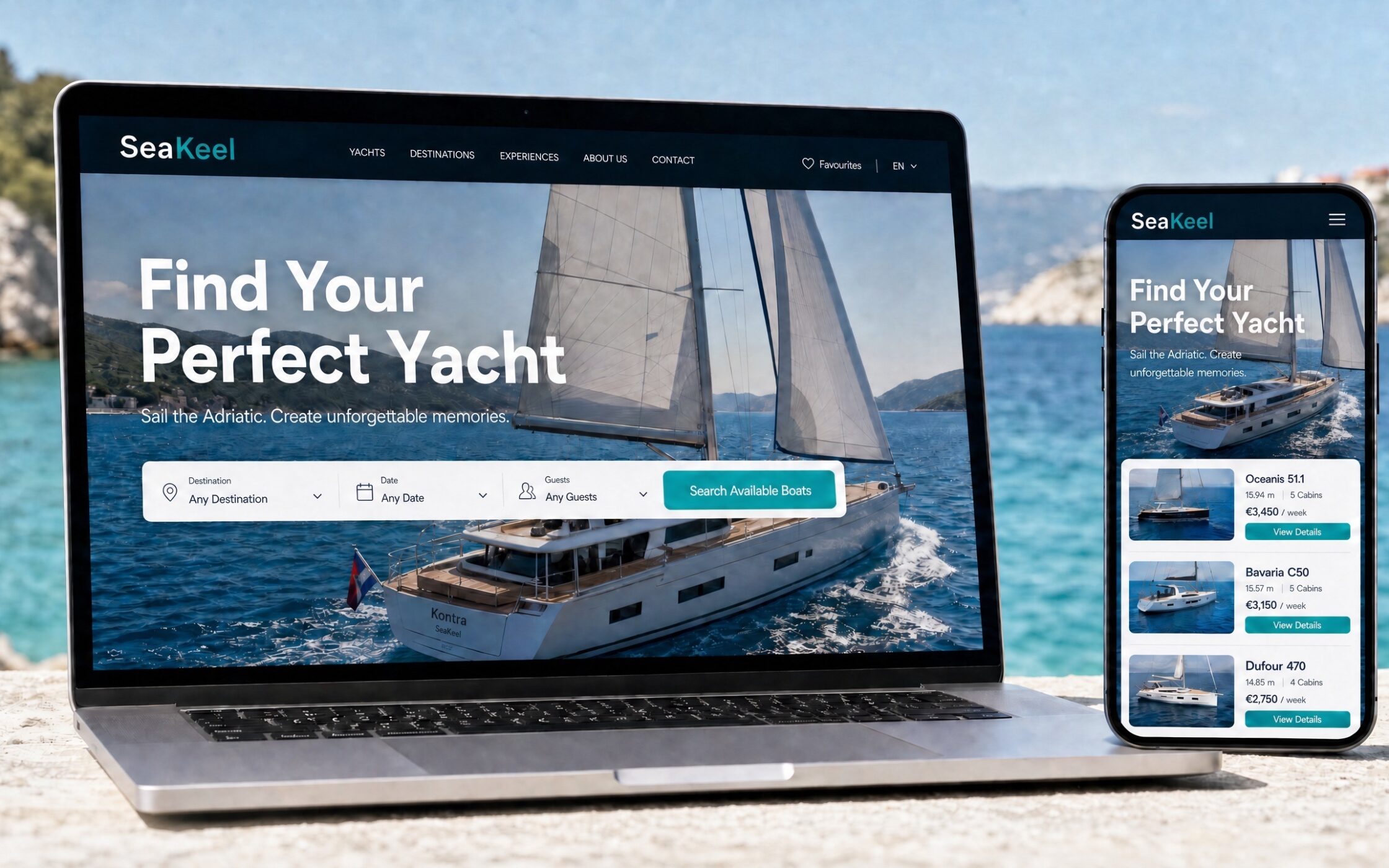

Yacht charter is among the most demanding e-commerce niches in terms of user experience (UX), business, and conversion rate optimization (CRO). High prices, fluctuating seasonal availability, and legal requirements – often only revealed at the final stage – create special challenges. The primary goals of a yacht charter website are clear: increase bookings, minimize drop-offs in the customer journey, and build trust. With digital bookings now taking an increasing share of yacht charters, a website must serve as more than just a digital brochure.
This article will cover: speed and performance, user experience and clarity, price transparency, effective search and availability features, trust-building elements such as reviews and credentials, flawless booking, and options for standing out. Each of these pillars is grounded in UX, conversion psychology, and technology integration, offering owners clear, actionable guidance.
Speed and Performance: The First Impression That Makes or Takes Money
Examining most charter websites today, a primary factor ‘destroying’ conversions is slow site speed. This issue usually stems from obsolete, underpowered servers that degrade performance and the user experience.
Additionally, content loading methods, image optimization, and delay of non-critical page elements are often poorly configured. Simple optimizations can have a significant impact. Compressing large images before uploading is helpful. Using efficient formats such as WebP further improves performance. Configuring the website to load visible content first also boosts speed. Another easy win is using a content delivery network (CDN) to achieve fast loading worldwide.
Research from Google shows how critical speed is: 53% of users will likely leave a site that takes more than 3 seconds to load on mobile. In an industry with high transaction volumes, every second of delay means significant losses. Website speed is directly linked to booking rates and revenue.
Clarity Over Aesthetics: What Do Users Really Want?
Charter operators frequently dedicate considerable resources to design, fine-tuning animations, palettes, logos, and trendy layouts. However, users don’t book because the site appears stylish. They book because navigation is intuitive, prices and availability are transparent, reviews and vessels are credible, and booking is simple.
Customers value reliability and clarity far more than visual appeal. An added issue is excessive scrolling – the need to swipe extensively to access the call-to-action (CTA) button, contact form, or intended action. Research conducted with 12,000 travelers from 14 countries shows that more than half (52%) report abandoning the online booking process due to a poor user experience.
Price Transparency: A Core Pillar of Trust
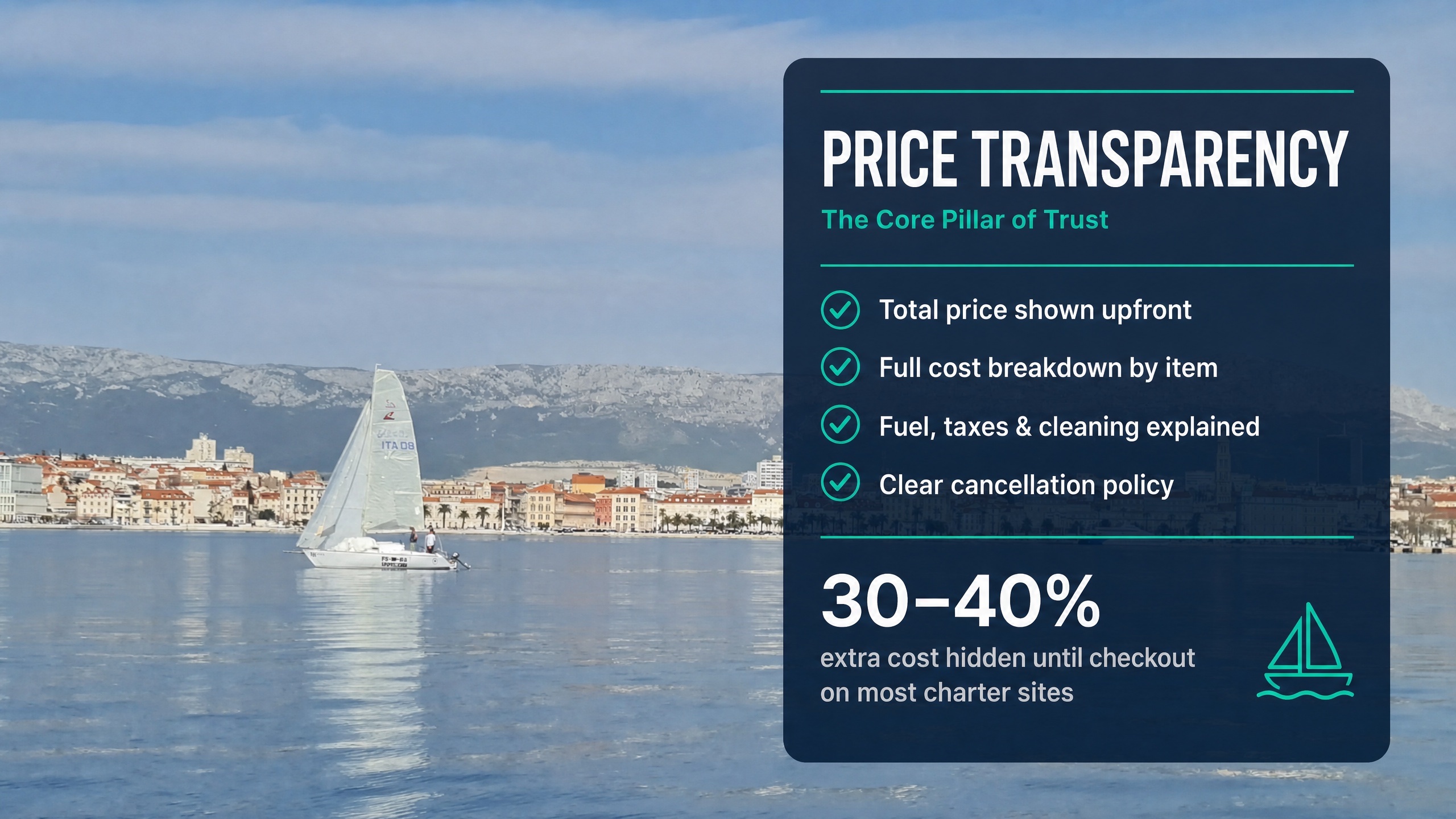
Present total cost – including all fees, taxes, and additional charges – upfront, not at the end. Displaying a ‘Base Price’ while users end up paying much more at checkout damages trust. Concealing costs such as transit fees, city taxes, and mandatory extras until the last step erodes credibility. Forcing users to send an inquiry just to view pricing is unacceptable.
| Good practice | Bad practice |
| Clear presentation of the basic price upfront | Request for an inquiry just to see the price |
| Complete breakdown of costs by item | Hidden fees that surprise the customer at checkout |
| Explanation of additional costs (fuel, taxes, cleaning) | Unclear definition of what is included in the package |
| Clear cancellation policy and payment terms | Payment information hidden in the small print |
Displaying the price per person (e.g., “400 €/week per person”) is essential to the user experience, enabling group renters to evaluate and rationalize high total costs instantly. Clearly communicate payment methods and terms. If installments are offered, state when, under what conditions, how, and deadlines. Use reliable payment platforms to provide convenient, secure options. These tools deliver flexibility for single or split payments while creating trust through secure, efficient processes.
Search, Filtering, and Availability Logic
Boat rental users fall into two camps: those who know the exact boat model they want and those who are generally searching for a ‘boat in Croatia.’ Critical advanced filters are often lacking. Experienced sailors require technical specifications (engine output, water capacity, solar panels), while vacationers prioritize lifestyle amenities (air conditioning, Wi-Fi, coffee maker, underwater lights).
Real-time availability is critical. Nothing degrades the user experience more than a user dedicating 20 minutes to searching for a boat, only to be told at the end, “Send an inquiry to verify availability.” Many charter sites lack a unified booking calendar that automatically syncs availability across all platforms, causing inefficient processes and delays. To combat this, integrating the site with booking engines or dedicated yacht charter software will streamline availability and decrease manual labor. These integrations provide users with accurate, up-to-date availability and help prevent double bookings and human errors. Adopting this level of automation is now broadly accessible and constitutes a major improvement for both agents and customers.
Never disregard the “Saturday to Saturday” rule. In regions like Croatia, rentals begin and end on these days. If users select non-standard dates, present the closest available alternatives with the message: “We don’t have boats for those dates, but here are the closest options.” You may restrict date filters to default to Saturday-to-Saturday ranges. If a user seeks different dates, advise them to send an inquiry.
Conversion Psychology: Establishing Trust Through Authority and Reviews
Besides the already mentioned clear pricing and real-time availability, visitors trust companies that demonstrate brand authority and social proof. These are the fundamentals for converting traffic into bookings.
Brand Authority
Brand authority shows the credibility and trust your audience, industry partners, and search engines have in your company. It is built through certifications, licenses, media coverage, awards, detailed company descriptions, and team bios. A common mistake is failing to highlight certifications and accreditations. Many sites use vague claims like ‘Trusted since 2010.’ They also hide key information deep in the ‘About Us’ page instead of showing it up front – such as on the homepage.
Social Proof
Social proof is a psychological process. People assume others’ actions signal correct behavior. A study in the International Journal of Hospitality Management found that increasing a guest review score by 10% can boost online bookings by over 5%. A common mistake is showing outdated or very few reviews. Charter sites often post only 3–5 old reviews, hurting credibility. Customers expect many recent reviews (at least 20) offering different views.
Product Page: This is where Assurance is Built or Broken
A boat is a major, emotion-driven purchase. The product page must erase doubts, support trust, and preempt any questions. A few items that will help with this are:
- Visual trust is essential. Stock photos of a boat model are a red flag. Good sites show actual photos – including the engine room, cockpit, restrooms, and boat at sea
- Spatial orientation matters. New sailors usually struggle to picture a boat’s layout. Add a floor plan of the boat. A 360° virtual tour is a useful bonus.
- Skipper problem: Many users are uncertain if a skipper is necessary. Good UX provides a ‘Do you need a professional skipper?’ button that explains requirements and pricing.
Ideal Booking Flow: Five Steps That Build Trust
The best booking process follows a “trust-building” path:
1. Discovery: Search with real availability and total price (including mandatory fees).
2. Shortlist: Comparison tool – allow users to compare 3 boats side by side (length, cabins, year, price).
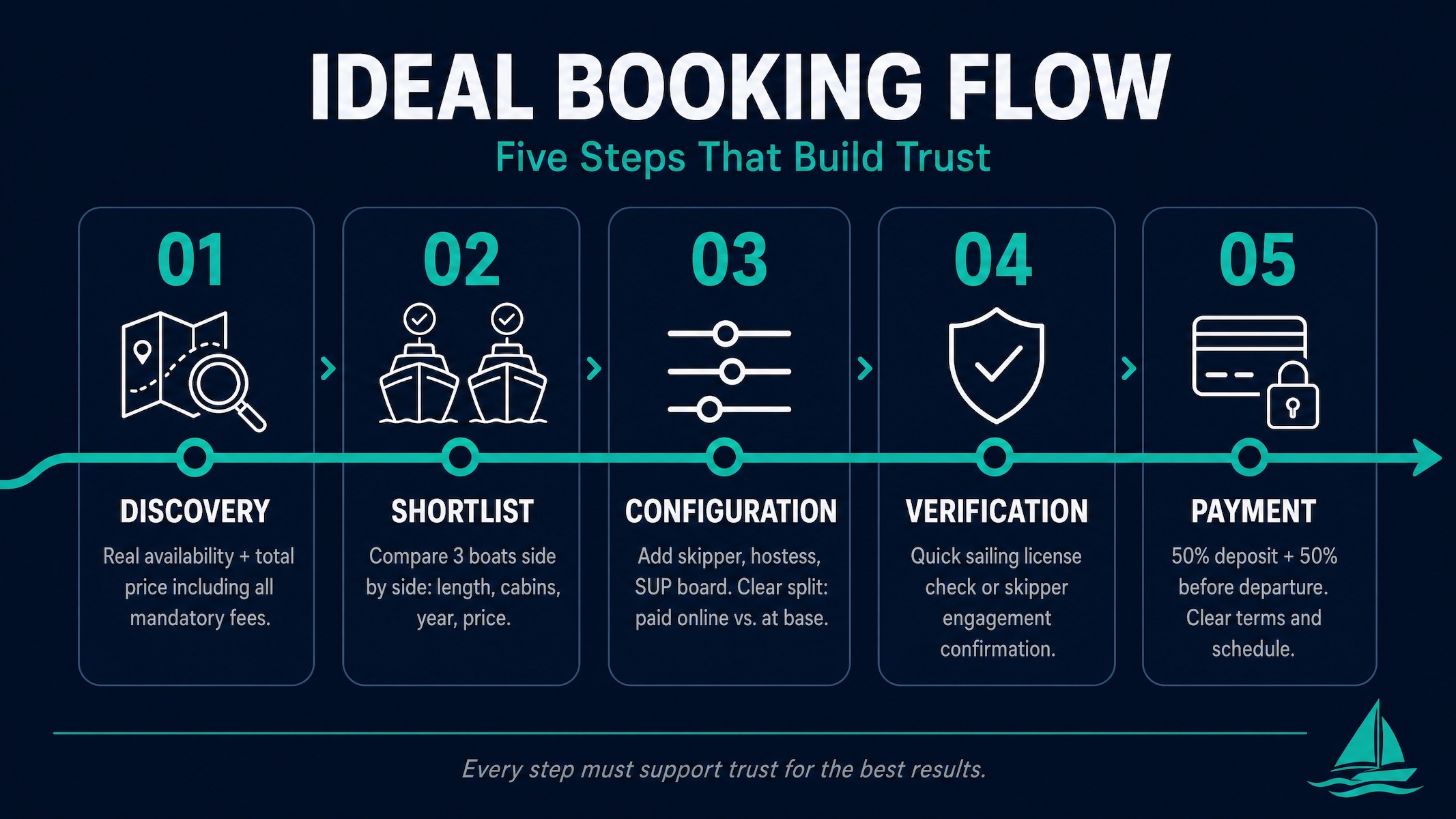
3. Configuration: Add-ons (e.g., skipper, hostess, SUP board, outboard motor) with a clear indication of what is paid online and what is paid at the base.
4. Verification: Quick check of sailing licenses or confirmation of skipper engagement.
5. Payment: Single or installment payment options (e.g., 50% deposit + 50% before departure) with clear terms and schedules.
Booking flows must support trust at every step for the best results.
Critical Point: Inquiry Realization
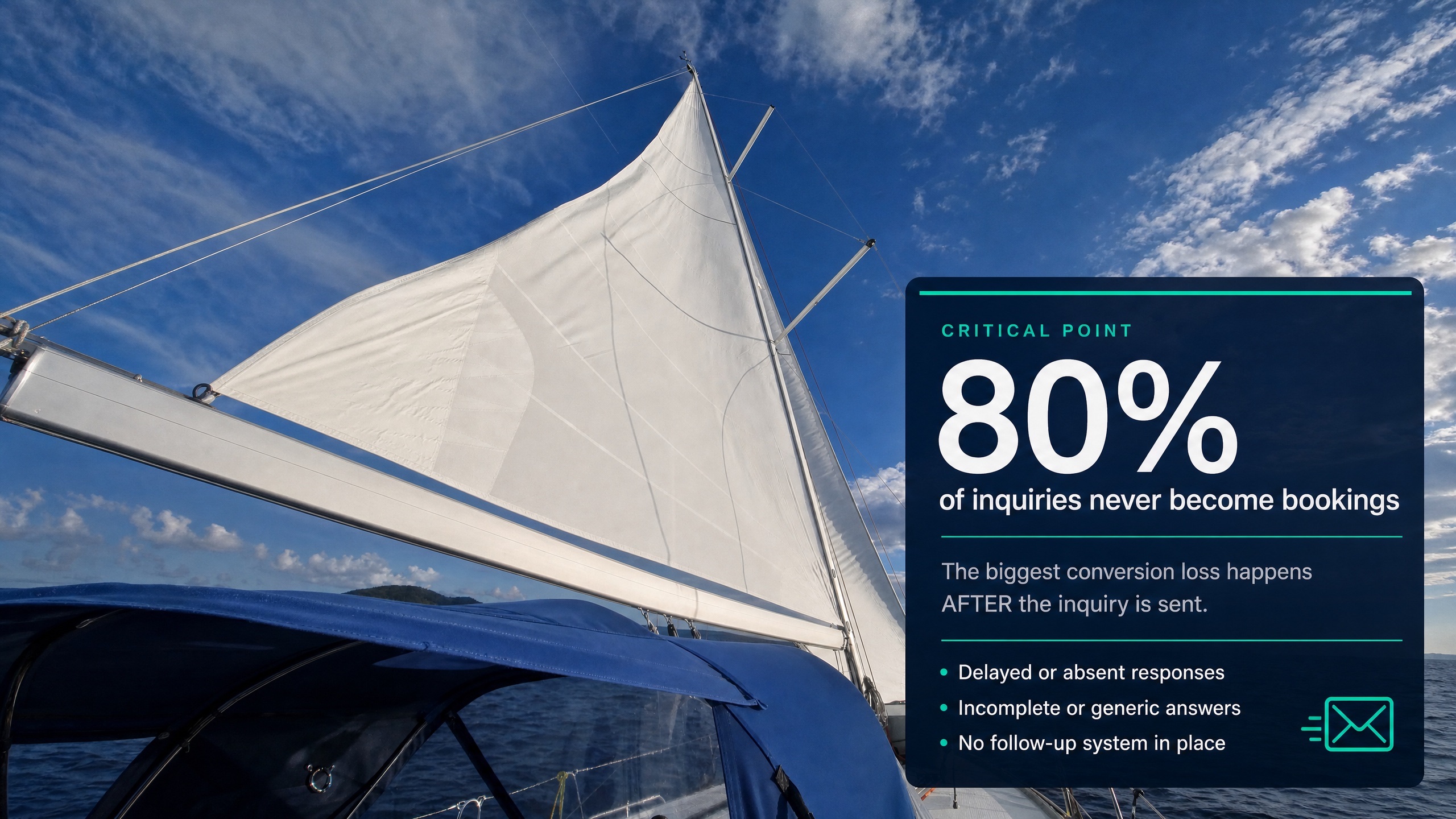
When a user, for whatever reason, does not want to book but sends an inquiry, a problem arises. Charter companies lose up to 80% of reservations after the inquiry. So, the website, including the search page and the ship page, might do a great job, but the process can break down in the final step: human interaction. Delays, absent responses, or incomplete answers are common pitfalls. Optimizing the inquiry-to-response flow is therefore essential, since this is where the biggest hidden conversion losses occur.
To address this, set up automated inquiry-acknowledgment emails that verify receipt and clarify when the user can expect a detailed reply. Implement clear internal targets for response times, such as striving to answer every inquiry within one hour during business hours. Make sure responses are accurate, personalized, and consistent, ideally using prepared templates that can be easily adapted for each customer. Consider tracking the status of every inquiry and automatically following up if no response is sent within your target timeframe. Today, you can also consider introducing an AI chat for simpler queries. These steps help reduce lost leads, improve customer confidence, and directly increase bookings.
What Else Can You Do for Your Website?
Differentiation: What Makes Charter Page Stand Out?
Considering that many charter sites look almost identical, what really differentiates one from the other today is personality. Customers buy an experience, a feeling, and people, not just a boat. Humor, warmth, or a distinctive brand voice are worth more than generic statements like “We’ve been sailing for 20 years”.
Clear positioning – who this charter is for – is key. Instead of trying to please everyone, focus on specific segments like:
- “Perfect for families with children under 12.”
- “Designed for luxury vacations for couples.”
- “Made for adventure lovers who put fishing first.”
Clarity increases trust because it seems intentional rather than generic.
Website Optimization
SEO (GEO, AIO – call it whatever you want) is still a competitive advantage because content and user experience optimization are parts of it. Technical SEO is even more important. We can compare it to building a house. If you want to be sure that the house will be safe and serve well, you must have a good foundation. The same goes for the website. To function well and have good results, the website must have excellent technical predispositions. Otherwise, everything goes down the drain.
For you, wondering where to start, here are a few essential technical SEO steps to give priority to:
- Make sure your website is mobile-optimized and responsive so it works smoothly on every device.
- Speed up your site’s loading times using techniques such as image compression, browser caching, and using a content delivery network (CDN).
- Use a secure HTTPS connection, so visitors see a secure padlock in their browser.
- Optimize crawling and indexation of your pages with a robots.txt document, XML sitemaps, and canonical tags.
What is Missing: Opportunities for Pioneers
Some functionalities that are rare, but have huge potential are:
- Integration of time and route into the search process: Display of “Suggested 7-day route” directly on the boat page, according to the starting marina.
- Split payment: Possibility for multiple friends to pay for each part of the boat individually within 48 hours to confirm the reservation.
- License check: A step of checking sailing licenses (or confirmation of hiring a skipper) on the boat page and/or at the start of the booking process (before the final payment), to prevent later problems and cancellations.
Conclusion: Planning Comes Before Design
A website entails careful planning. Define your goals, expectations, target audience, technical integrations, and evaluation procedures. Focus on user experience, transparency, and navigation simplicity.
A bad charter website is easy to notice today:
- Asks for your phone number before displaying the price.
- Photos look like they came from a 2010 brochure.
- Not optimized for smartphones.
- The checkout price is significantly higher than the search price.
Investing in transparency, speed, and an effortless user experience is a direct way to increase bookings and grow your business in the yacht charter industry.
If you have any questions or concerns, we will be happy to help you.


