
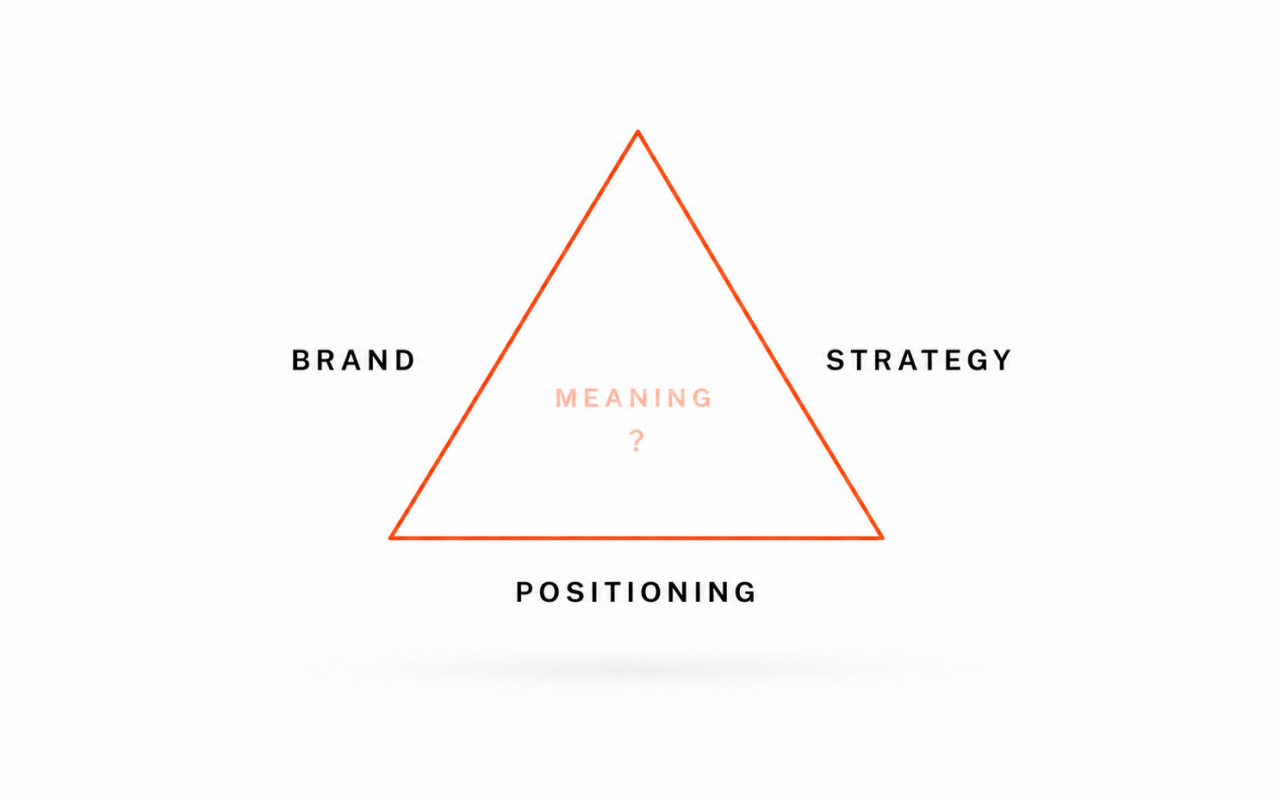

Brands no longer compete solely on product quality, media budgets, or reach. In a market saturated with content, ads, and increasingly similar execution, the real differentiator is perception. In other words, meaning.
This article explores why brand strategy matters more than ever, how positioning shapes the way brands are understood, and why consistency has become an advantage that goes a long way, both figuratively and literally. We’ll also look at the building blocks behind strong brands, from purpose and messaging to visual identity and emotional connection, along with examples from global and regional markets.
The market of sameness
Seems like only yesterday, being ‘good enough’ was enough.
You had a cool product, a functional website, and a few campaigns running. Things worked. Nothing spectacular, but safe and predictable. You were growing… but not by differentiation. That time is gone.
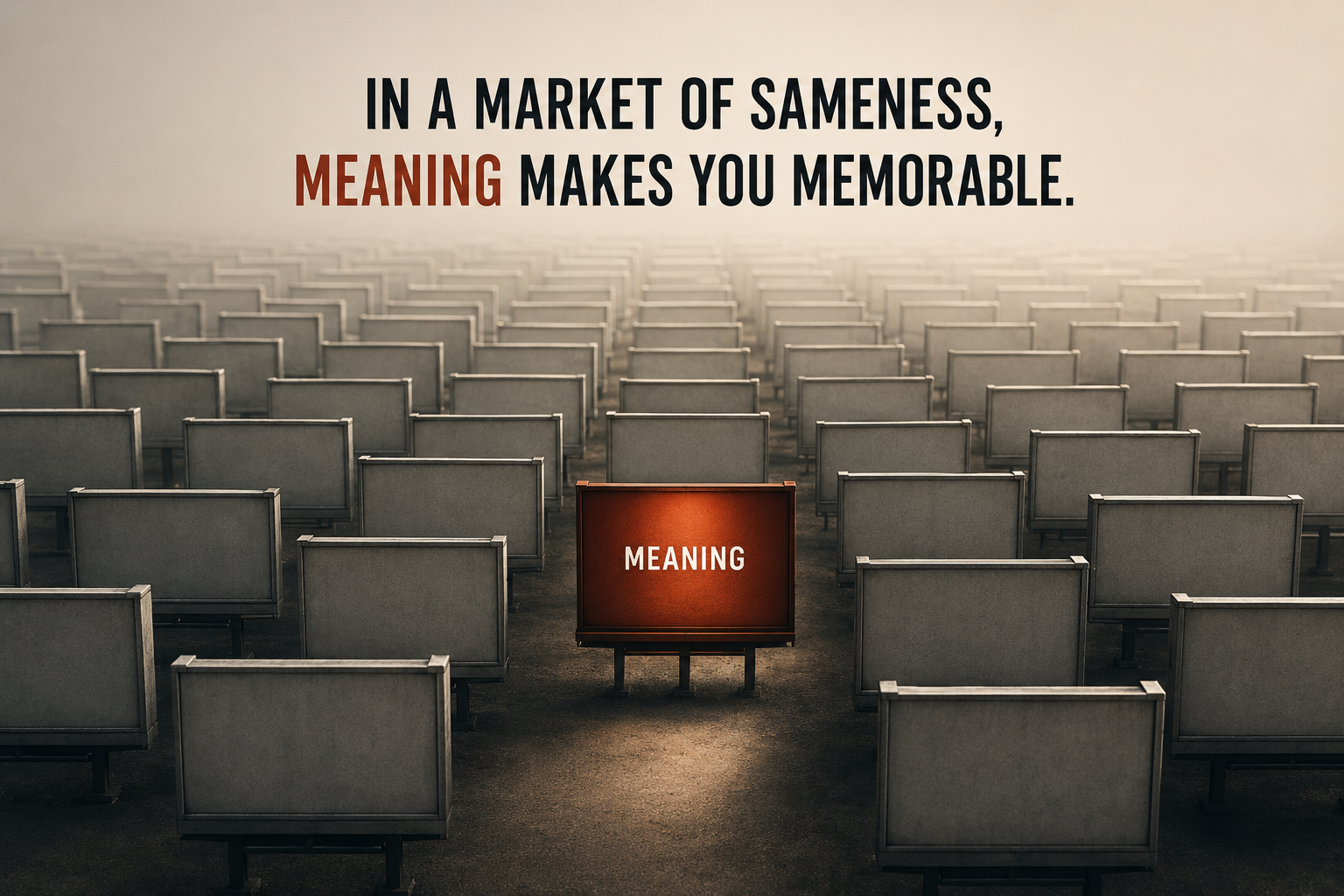
Today, everyone has access to the same tools. Everyone can generate content, design visuals, launch ads, and optimize campaigns. AI has flattened the playing field to a point where average execution is almost effortless. Some would argue it’s a big win for mediocrity.
However, when everything looks, sounds, and feels the same, the question is no longer who can execute better. The new question is: Does anybody actually stand for something? Does anything have any real meaning?
This is where brand strategy comes in. We need it to define the brand’s position. And position defines meaning.
What brand strategy actually is
Brand strategy is not your logo, your color palette, or your latest campaign. Those are just outputs. It’s about how we get to the point where you put stuff out.
Brand strategy is the system behind the outputs. The logic that defines how a brand behaves, communicates, and shows up over time. It’s what turns random marketing activities into something cohesive. But here’s the part most brands miss.
Brand strategy without positioning is just documentation. The role of brand strategy is not to describe your brand. It’s about defining the position you want to occupy in people’s minds and consistently earning it.
If that position is unclear, everything downstream suffers. Messaging becomes generic. Campaigns become inconsistent. Growth becomes expensive. Your actions seem random to the point of seeming pointless.
Sooner or later, you start competing on things that don’t scale: price, discounts, attention spikes.
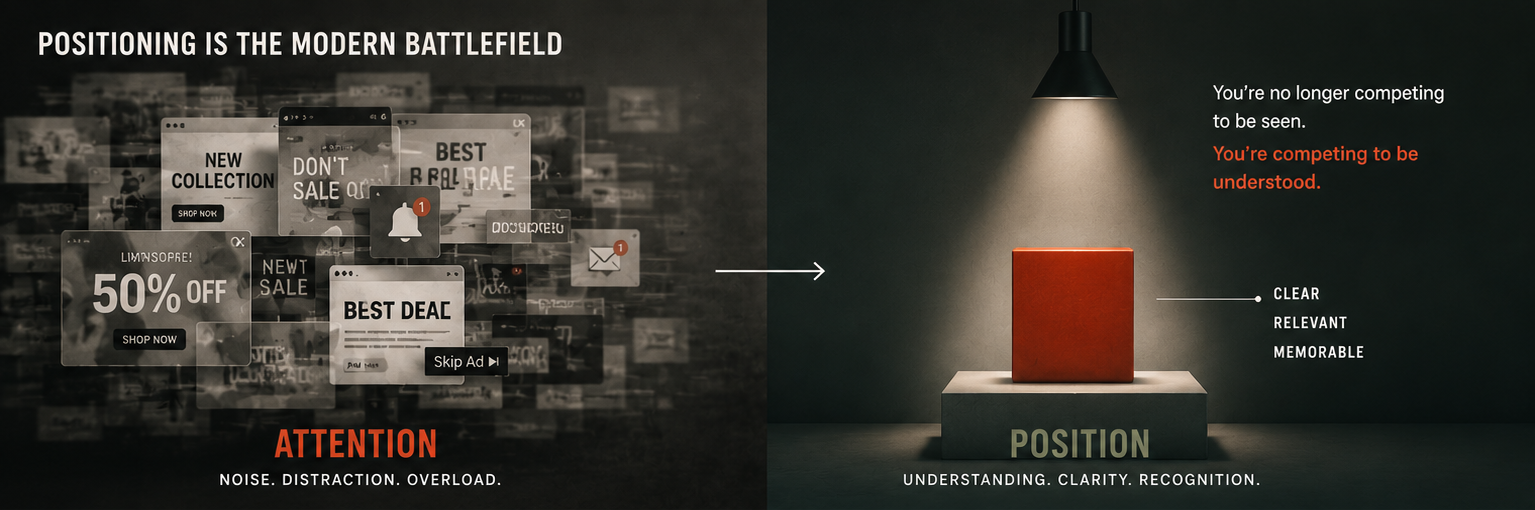
Positioning is the modern battlefield
A while ago, brands competed on reach. If you could get in front of more people, more often, you would grow. Today, distribution is accessible to everyone. Attention is fragmented, and ‘sameness’ is everywhere. This changes the game completely.
You’re no longer competing to be seen. You’re competing to be understood. More so, understood instantly. And that’s positioning.
As Al Ries and Jack Trout famously put it, positioning happens in the mind of the customer. Not on our website or our pitch deck. In their mind. All of our minds, actually. We are all subject to marketing and/or propaganda, whether we’d like to admit it or not.
Now, here’s the uncomfortable part. If you don’t define your position, the market will do it for you. Probably in the least favorable way possible.
The building blocks of a brand that holds a position
A strong brand is much more than a collection of elements; it’s a system that reinforces the same idea from multiple angles, over time.
It starts with purpose. Not as a mere tagline, but as a directional force. Purpose defines why you exist, but more importantly, it defines what kind of space you want to occupy. Without that, positioning becomes reactive. Reactive, meaning it reacts to external market stimuli rather than following its own direction.
Values come next. Values are visible in decisions, not in self-deluding proclamations written all over office walls. Values signal what you prioritize, and that shapes how people interpret you. Over time, that interpretation becomes part of your position.
Positioning answers a simple but difficult question: When people think of your category, what role do you play in it? If the answer is vague, you don’t have positioning. You have presence.
Messaging is how that position becomes recognizable. A single campaign won’t do it, but repetition will. Your ideas, framed in (slightly) different ways, over and over again. Because consistency is what moves something from ‘heard once’ to ‘remembered’.
Visual identity supports that memory. It’s actually a mental shortcut disguised as decoration. A way to recognize the brand before processing the message. Over time, visuals become linked to the position you’ve built. You can see our work in that department here.
And then, there’s the story. A story is something that emerges when all the pieces align. A coherent narrative that people can follow, remember, and retell. Again, here’s our own example.
Building a brand strategy means choosing a position and committing to it
Ideas aren’t the issue. Most brands don’t struggle with ideas; they struggle with decisions. Building a brand strategy is about deciding what you will be, and, just as importantly, what you won’t be.
It all starts with understanding your audience properly, who they are, and how they see the world. What they value, what they reject, what signals they respond to. As Seth Godin would frame it, you’re defining ‘people like us’. Kendrick Lamar’s ‘Not like us’ definitely doesn’t apply here; although Kendrick is also a type of brand.
OK. So, from there, you define your differentiation. However, not every difference matters. The goal is not solely to be different; it’s to be meaningfully different in a way that supports a clear position.
Then comes alignment with business. Positioning is not a creative exercise. It has to support how you grow, where you compete, and what you can realistically deliver. Otherwise, you create a gap between promise and experience, and that gap erodes trust.
Messaging and voice turn that position into something repeatable. If it can’t be repeated, it can’t be remembered. And if it can’t be remembered…Well, you already know.
Finally, you build a system around the position.
Guidelines, rules, patterns, and all the things that ensure the position doesn’t drift over time. Because the real risk is not getting positioning wrong, but slowly losing it through inconsistency.
Just imagine how it feels for Yahoo to see Google become not only the number one search engine, but an actual verb in languages all over the world. That’s one among many brand examples.
What makes positioning stick in practice
Knowing your position is one thing. Holding it is something else entirely. Strong brands don’t just define positioning, they defend it every day, across every touchpoint.
They rely on clear messaging frameworks to channel creativity. Every campaign builds on the same idea instead of starting from scratch.
Smart brands invest in visual systems that reinforce recognition. Because if people don’t recognize you, they can’t remember you. And if they can’t remember you, your position never forms.
They document things to ensure that as teams grow, the brand doesn’t fragment. Because inconsistency is positioning’s biggest enemy. They align internally.
A brand is not what marketing says, it’s what the company consistently does. If different teams within the same company interpret the brand differently, the market will experience it as confusion.
Strong brands build emotional connection. As Marty Neumeier (poetically) defines it, a brand is a gut feeling. Positioning is not just understood, it’s felt. And feelings come from repetition, familiarity, and coherence.
And above all, strong brands stay consistent. It may appear the reasoning is about ‘playing it safe’, but it’s because it’s effective. It’s what turns a message into a pleasing thought, a pleasing thought into a memory, and a memory into a default choice. In any case, consistency is prudent.
What this looks like in the real world
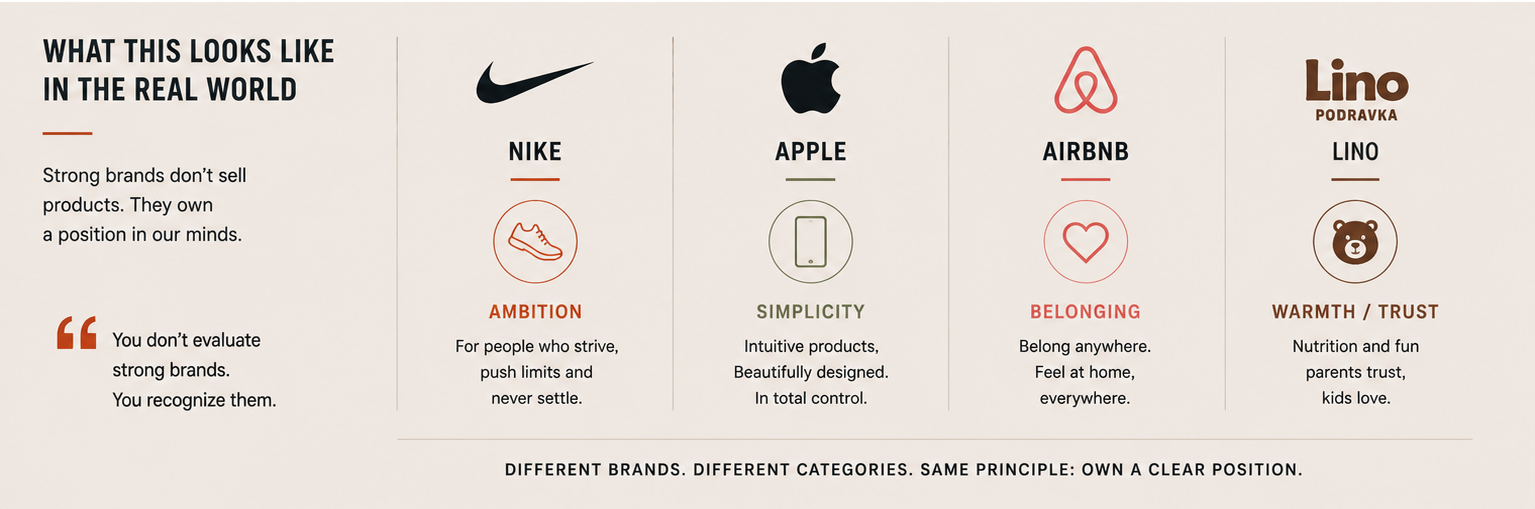
The easiest way to understand positioning is to see it working. Let’s look at some of the brands we all know, as well as a successful Croatian/regional example. We’ll take a glimpse into:
- Nike
- Apple
- Airbnb
- Podravka
Let’s start with Nike. Nike Inc. isn’t Whatever Inc.; it doesn’t just sell sportswear. It owns a position around ambition, effort, and personal progress. Their market philosophy runs deep. Every campaign, every product, every collaboration reinforces that same idea. You don’t evaluate Nike, you recognize it. Interestingly, Nike wasn’t always Nike. The company originally operated as Blue Ribbon Sports before rebranding in 1971, a move that reflected the need for a stronger, more distinctive identity. Even the name itself became part of the positioning: short, symbolic, memorable, and emotionally charged.
Apple Inc. holds a different position, one of simplicity, design, and control. Not as messaging, but as experience. The positioning is so clear that even small deviations would feel off.
Airbnb didn’t win by offering more listings. It won by reframing the category from accommodation to belonging. That’s why it dominated the market to the point that major European cities had to change their housing strategies altogether. This shift from ‘soulless’ practicality to emotion created a position competitors couldn’t easily replicate.
Test yourself by opening Booking and comparing its UX to Airbnb’s. It’s clearly not just about the interface. The interface is a digital facade. It’s the output we’ve already mentioned. What matters is what’s behind the output, or prior to the output.
When it comes to Croatian brands, let’s take a brief look at Lino by Podravka. What makes Lino interesting is not just recognition, but clarity of position. It’s much more than ‘children’s food’, it’s a brand that lives in the space between nutrition and entertainment.
It speaks to children through familiarity and play, but to parents through trust and reassurance. The mascot is a carrier of that position, a symbol of safety, warmth, and continuity.
Take a second to take that in. It’s like a permanent mental tattoo over your childhood. And most importantly, it hasn’t drifted; over the years, even decades, the same feeling has been reinforced. That’s what makes it powerful, it’s accumulated consistency.
You don’t need to rethink Lino every time you see it. You already know what it is. That’s positioning for you.
Conclusion
In a market where everyone can execute, execution stops being the advantage. In a market where everyone can distribute, distribution is no longer an advantage. What remains is perception. In other words, where you sit in the customer’s mind.
That position determines whether you’re:
- noticed or ignored
- compared or chosen
- remembered or forgotten
Brand strategy is how you define that position. Consistency is how you build it. Time is what makes it stick.
And perhaps that’s the real shift happening now.
Products can be copied. Campaigns can be replicated. Entire visual systems can be reproduced in a matter of hours. But meaning is harder to imitate. A clear position, reinforced consistently over time, becomes something much more durable than attention.
Brands that manage to hold that position long enough eventually stop chasing relevance. They become the reference point instead.


