
Marketing investments are often viewed as a necessary evil or as a direct response by the board. One thing to keep in mind is that board members are not evil; they have their own perspectives. If you are a marketing director, a brand manager, or any other marketing personnel in the company, this post is for you. If you are a board member, you will likely have greater influence on the rest of the board, but also higher expectations. The key point when discussing marketing investments is that you cannot speak to everyone the same way when requesting a budget grant. By reading this blog post, you will master the basics of converting your project ideas into reality.
Introduction: Why Go Through All This Trouble For a Marketing Investment?
Well, you don’t have to, but this is basically the difference between doing your job well enough to avoid getting fired and being amazing at your job. And being excellent at your job means earning respect, a promotion, greater job security, and maybe even recognition among peers.
Step 1: The P&R
Do not worry; this is not another corporate acronym you should know. I just made it up this moment. It simply stands for “The preparation and research“. Any serious work today starts with these two processes. Asking for marketing investments is no different. What should I prepare for, and what should I research? First, you should prepare for serious work. Mind preparation is key. It all depends on several things:
- How significant is the marketing investment
- What is your current status at your company
- Do you have some previous successful projects at the same company
- What is your relationship with the board
- How long have you been in the company
- …
In other words, it depends on a lot of things, but you get the gist of it.
When speaking with board members, be sure to understand what matters to them. In most cases, it’s all about the money. I’m not claiming that’s the only thing board members care about, but it’s always a significant part of everything the board does, and often the reason behind it. Let’s not fool ourselves. If we’re talking about a for-profit company, which we are here, their primary goal is in the name itself. There are many organizational types, such as political parties, nonprofits, and charitable organizations, but in this blog post, we’re primarily discussing the first type. What is also important to know is that everything else, including marketing, is devoted to achieving that ultimate goal.
So, when talking to the board about a marketing project, the first thing you should ask yourself, and ultimately build your preparation and research on, is the question: “Will it earn money for my company?” You might fool yourself, but this is one of the first things your board members (or your CEO) will consider.
Step 2: The plan
Brian Tracy said, “Every minute you spend in planning saves 10 minutes in execution; this gives you a 1,000 percent return on energy.” There are dozens more quotes on the importance of planning, and all of them point to the same conclusion – planning is essential. The difference between a marketing expense and a marketing investment lies in good planning. If you did your due diligence in research, the next step is planning. Now, since you’re in the planning phase, define a couple of things:
- Define the problem: If you can’t explain the problem your marketing project solves in one or two sentences, stop and figure that out first. Ask yourself – What is broken, missing, or underperforming, and why does it matter now? What happens if you don’t do it?
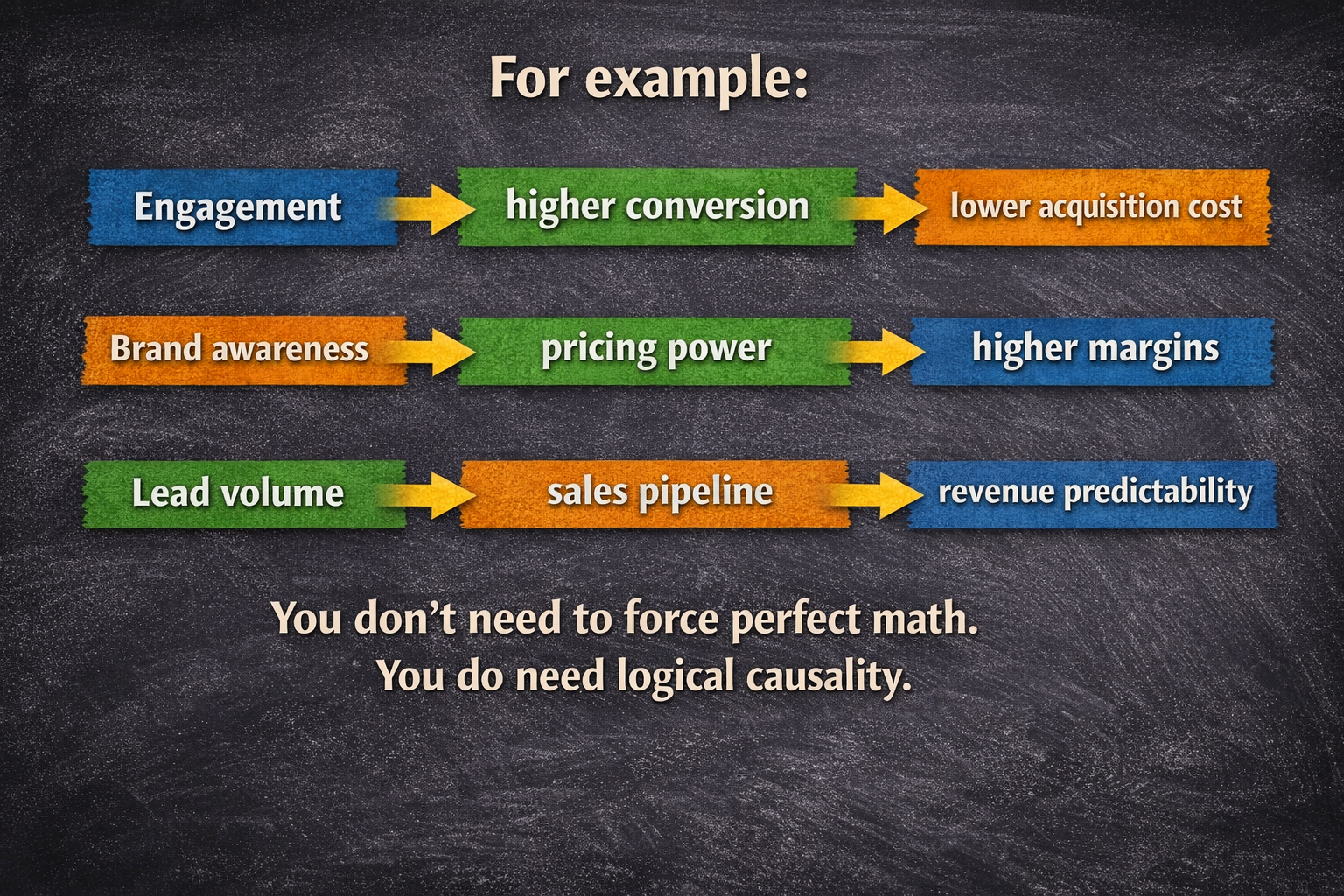
- Outline the goal in business terms: There’s a 99,9% chance the board won’t care for boosting engagement or raising brand awareness. What they’ll care about, though, is increasing qualified leads by X%, reducing customer churn by Y%, and growing revenue by Z%.
- Identify the strategy (Identify The How?): Be sure to explain the overall approach here, not the details and those little ins and outs. For example, the plan is to build a content engine to drive inbound leads.
- Map out the tactics: “We plan on doing something cool and innovative.” – No! You will immediately lose the board’s attention, if not irritate them. What are the exact activities you plan on doing and why?
- Estimate the budget immediately: This is an important step! Don’t be vague, don’t say around €50K. The board members will want to know: What’s the money for? Why does it cost that much? How did you arrive at that number? Can it cost any less?
- Define the timeline: A goal without a deadline is just a dream. If you plan an activity that will last a year, it really has to be big. But, at the same time, and this goes for all of these, be concise – the board doesn’t need to know every little task
- What does success on this project mean: People don’t “buy” the drill, they’re buying a hole in the wall. In other words, the board will buy into the outcome rather than the process. Define the project’s KPIs: cost per acquisition, market share increase, ROAS,…
- Tell it like a story: The story? Yes, although the board consists of big, serious, sometimes even scary people, they must understand you, define the story around the problem, the opportunity, the plan to capture it, and why this idea is a winner right now.
Once you have all these points, you will feel your plan is outlined and becoming bulletproof. You won’t be scared of questions; you will welcome them with eagerness to respond.
Step 3: Build a business case
During this step, most marketing proposals quietly die.
Your idea might be so good that you could easily fall into the trap of declaring your board incapable of comprehending marketing – but that’s most probably not the case. Be aware, you want to achieve a marketing investment. That’s why you need to create a business case. Boards are most often not interested in campaigns; they are interested in investments. Marketing is undoubtedly a proven investment, but you cannot rely on it alone to achieve your goal, which is a marketing investment. Always be aware that, besides marketing, the board has other options – new hires, product development, acquisitions, infrastructure, debt reduction, etc. The marketing project is just one of several equally important items on the list. If you want your project realised, here’s what to do.
- Start with money: The first uncomfortable question to ask yourself is – How does this project make the company more money or protect the money it already makes?
- Know: What you want to do, what it costs, and what the expected return is.
- Think in terms of revenue, not activities: The harsh truth is that the board doesn’t really care about activities. You should know the tactics of achieving your goal if the board asks about them, but the intuition here should be to justify the risk by saying “We want to invest (this much) to generate (this) or the long-term value is (this).
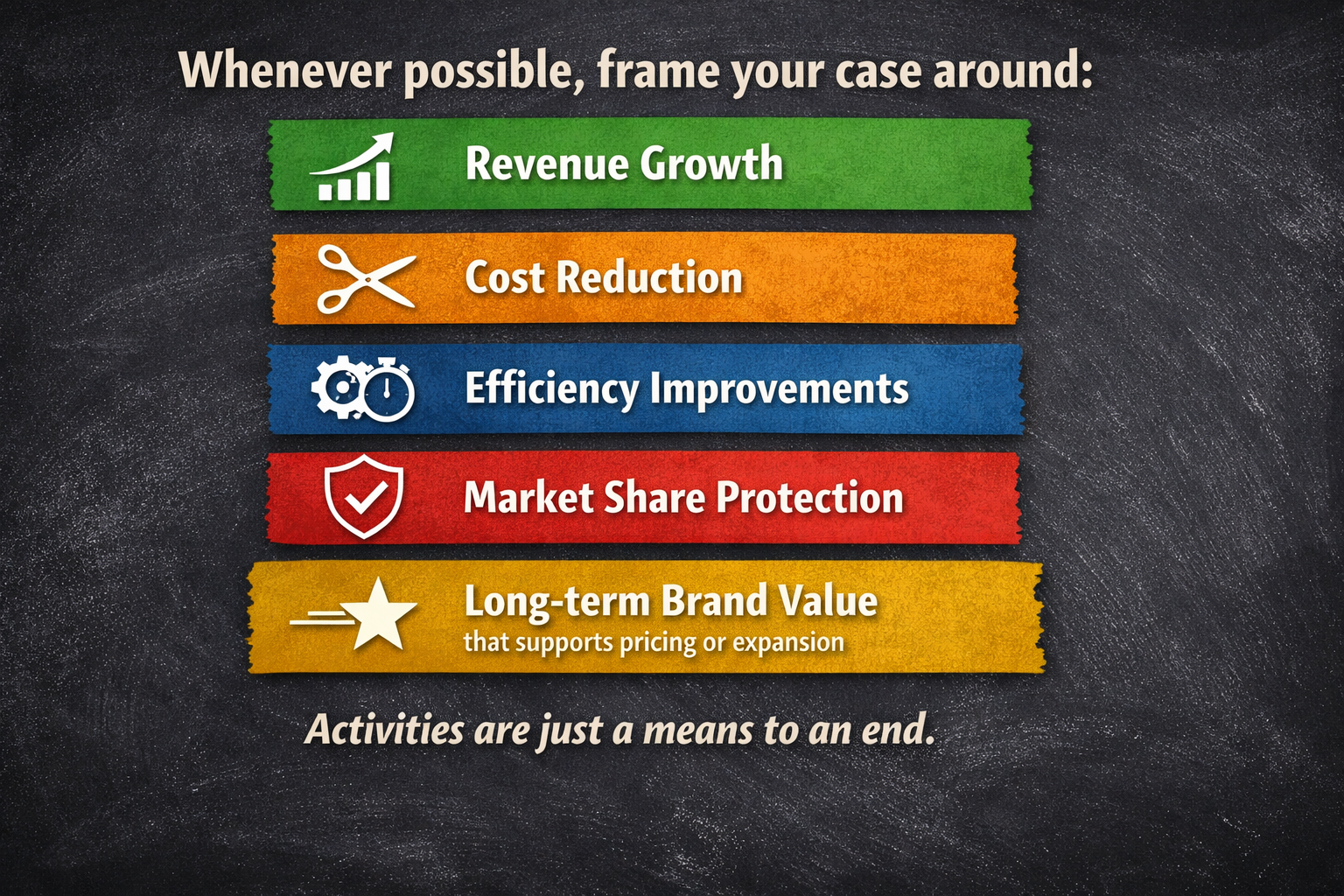
- Don’t hesitate to acknowledge uncertainty: There are no guarantees in marketing. Everyone knows that. Trying to prove differently will only make you look like an optimistic junior. Rather than explaining assumptions clearly, show predictions as ranges rather than pinpointing precise values. This signals maturity and trust
- Put things into perspective: You might not like it, but your proposal is competing with other uses of available capital. The board will want to know, so why not answer: Why not spend money elsewhere? Why do it now? What happens if we don’t do this?
- Keep it simple: There might be a huge amount of work behind your project, but the fact is, you are in complete control of your proposal only when you can explain it in simple terms. Summarize: What your asking? Why does it matter? What’s the cost? What’s the return?
This part is a make-or-break one. It will turn you from “That marketing person asking for money” to “A business-minded leader”. It goes without saying that things will be much easier next time. Not to mention if your project succeeds.
Step 4: Translate Marketing Talk Into Board Talk
This is a straightforward one. Marketers, like any other experts, might make the common mistake of talking to people in other vocations in marketing lingo. All with the aim of sounding smarter. Metrics such as impressions, clicks, engagement rates, reach, and brand lift are not useless; they just don’t convey the right message to the board.
If you show a meadow to a biologist and to a real estate agent (or a construction investor), they will see the same thing, but will have two completely different views on it. The biologist will want to know about the meadow ecosystem, while the realtors will consider what could be built on it. In this story, you are the biologist, and the board is the realtor.
So, to conclude, you should connect marketing metrics to:
- Revenue
- Profit
- Cost efficiency
- Risk Reduction
- Long-term competitive advantage
If it doesn’t, either: - You’re not explaining it properly, or
- It doesn’t belong in the boardroom
Remember, talk to the board as if they don’t live in your world, but are intelligent and busy. It’s about respect & simplifying, not about “dumbing it down”.
Step 5: Be Honest About the Risks
Let’s look at it like this. The people on the board are founders, entrepreneurs, investors, etc. All these roles share one common factor: risk. So, the biggest mistake you can make is to try to explain how the marketing investment you’re asking for carries no risk. That’s being an optimistic junior again. When communicating risks, don’t just say “this might perform worse than we expect.” Try thinking about these instead:
- Audience fatigue
- Channel saturation
- Rising acquisition costs
- Sales-marketing misalignment
- Operational bottlenecks
- Timing issues with product or pricing
When you name the risks clearly, they become your groundedness. And when it comes to risks, it’s important to know and communicate how you’ll monitor them. You’re going for a “nothing can surprise me” moment. For each major risk you detected and specified, be ready to answer:
- What’s the contingency plan?
- What decisions will be triggered?
- When do you stop, or scale down?
Just remember, anyone can pitch the pros, but what really makes you confident and in touch with reality is being able to look the cons in the eye and say, “I know you’re here; I’m not afraid of you because I know how to handle you.”
Step 6: Tie Your Project Directly to Company Goals
This step is important just as any other to this point.
You can have a solid business case.
You can speak the board’s language.
You can manage risks as a pro.
Unfortunately, these alone are not enough if your project feels disconnected from your company’s overall direction. Fail here, and your proposition will land straight in the “denied” drawer. On the bright side, there are questions you can ask yourself to test if your proposal is aligned with the goals of your company:
- What are the companies shor-term priorities?
- What is the long-term strategy?
- What are the board and the CEO currently worried about?
If you don’t know the answers to these questions, you’re doing the guesswork and putting the desired marketing investment at risk. If you have answers to these questions, be sure to align your project with those goals.
Show That Marketing is Vital for Achieving the Bigger Goal
A subtle, but powerful move. If you manage to show that without marketing, the company will have:
- Slower progress
- Higher costs elsewhere
- Increased pressure on sales
- Greater execution risks
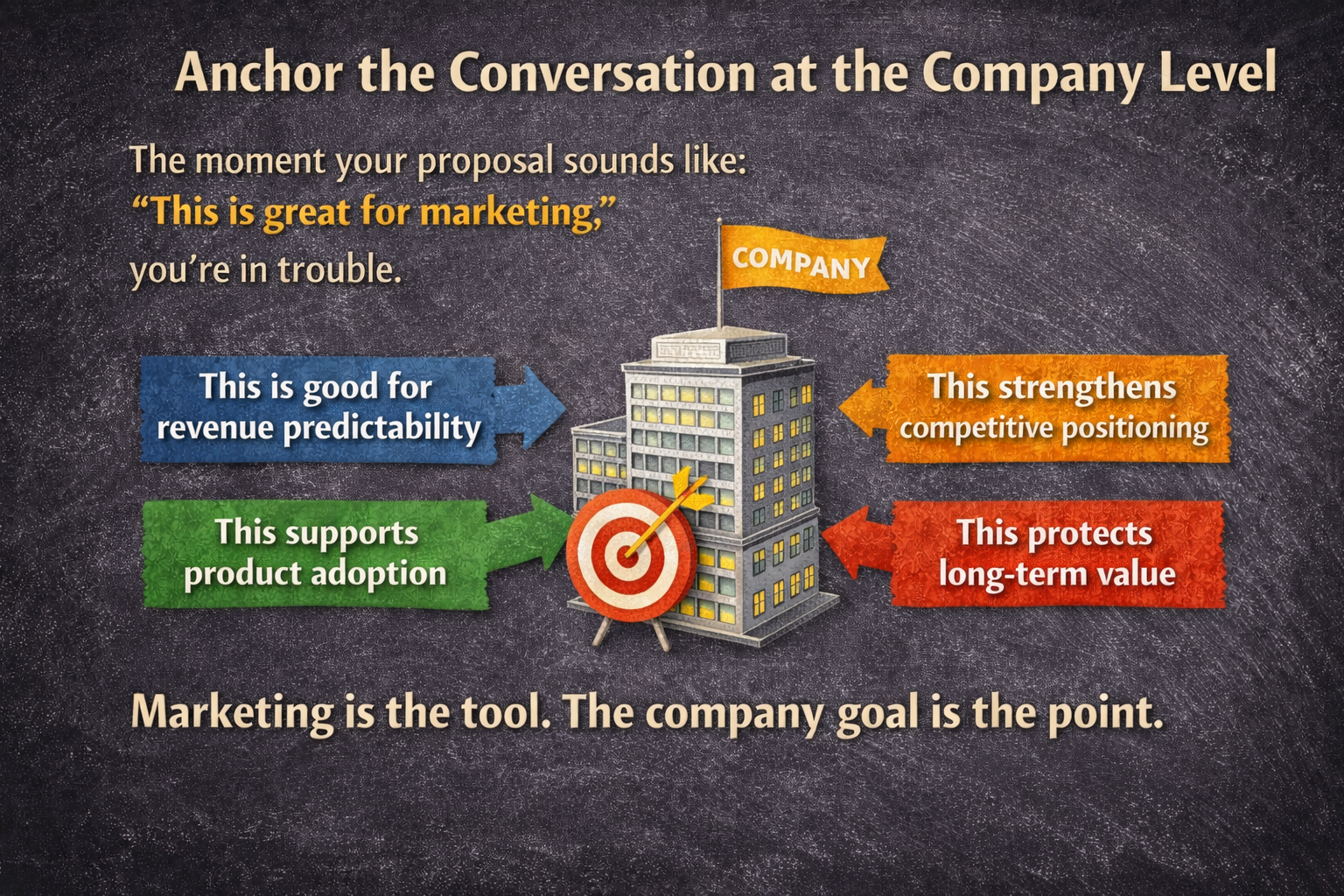
You will be on the right track towards realizing the marketing investment you’re hoping for. Put marketing in the context of a tool, while the company’s purpose remains the focus.
Step 7: Present Options, not Ultimatums
Nothing makes a person uncomfortable as fast as feeling cornered. Remember, the people on the board are still PEOPLE. However frightening they might seem to you. Boards are used to evaluate alternatives. That’s literally their job. So instead of forcing a yes-or-no decision, give them something they’re far more comfortable with, and that’s choices. What helps is having different levels of your proposal:
- The Conservative option: Lower marketing investment, lower expected return, lower risk
- The Optimal option: Balanced investment aligned with strategy and expected outcomes
- The Aggressive Option: Higher investment, higher upside, higher volatility

In psychology, this marketing tactic is called the multiple-choice phenomenon. If there is no multiple-choice option, the answer is Yes or No; if there’s a multiple-choice option, the answer is one, two, or three.
Step 8: Bring Proof – Benchmarks, Examples, and Evidence
The good news is that if you have reached this point, the worst is behind you. The bad news is, you’re not done yet, and there are several more steps. Such is life. Once you’ve shown that the idea makes business sense, aligned it with company goals, managed risk, and given the board options, it’s time to move from reasonable to comfortable. On the simple premise that boards trust evidence more than confidence lies, this step. You have the latter; it’s time to establish the first.
Use External Benchmarks to Anchor Expectations
The key here is to move away from emotion. While marketing relies greatly on emotion, the yay or nay on the marketing investment, i.e. business lies on evidence. For example:
- Industry benchmarks for acquisition cost or conversion rates
- Market growth data
- Typical ROI ranges for similar initiatives
- Public examples of competitors or comparable companies investing in similar approaches
If you have internal examples, use them. Remember when I said that it would be easier next time? That doesn’t mean it will be easy, but once you’ve established your position, the game significantly changes.
Evidence Only Works When Clear
Again, it’s about being sure you will be understood. That demonstrates you are on top of all aspects of your proposal and moves you one step closer to the desired marketing investment. That means:
- Simple visuals
- Clear takeaways
- Minimal marketing jargon
By the time you reach this step, you’re no longer selling marketing; you’re moving past uncertainty. That also brings you one step closer to approval.
Step 9: Delivery
Always bear in mind, your goal is not to impress, it’s to enable a decision. You won’t get extra points if you show how much work went into the plan, try to prove how deep your expertise is, or cover every possible angle. Remember, the board is short on time, and if you take up too much of it, it could end poorly for your marketing investment.
Start With the Answer, Not the Story
When you’re delivering your sales pitch, be explicit about:
- What are you asking for?
- Why does it matter?
- What decision do you want today?
Your delivery may be interesting and professional, but board members often have a lot on their minds. By starting with the conclusion and showing what’s on the table from the outset, it’s less likely someone will tune out.
Control the Narrative With Structure
When you have a clean structure, the discussion is less likely to drift from your goal. Here’s an example of a solid flow:
- Decision needed
- Problem or opportunity
- Proposed options
- Risks and mitigation
- Expected Outcomes
- Next Steps
If you present your project clearly, the board might go quiet. It’s important that you do not panic at this moment. Silence is usually the sign of thinking, not rejection. Silence is also your friend when presenting. Just because the board members don’t have much time doesn’t mean you should rush through what you wanted to say. Leverage the power of the pause. Not only will you sound more confident, but you will also be easier to understand.
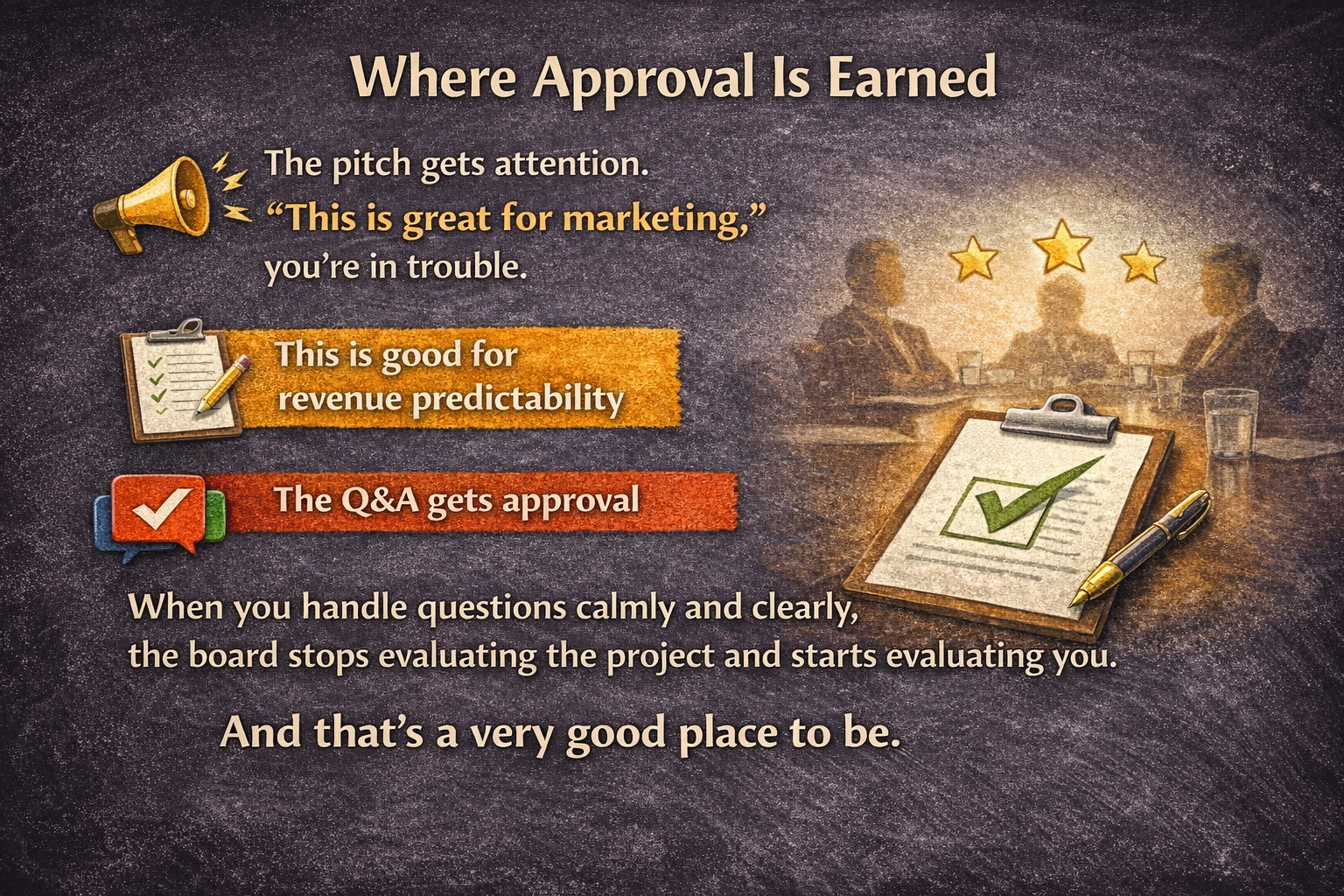
Step 10: Prepare for the (Uncomfortable) Questions
Boards don’t ask randomquestions. With their questions, they will aim to test your assumptions, probe risks, and assess whether you have really thought this through. If everything about your proposition were clear, there wouldn’t be a lot of questions, but each one would matter. The key, as you guessed, is to prepare in advance. If you’ve done that right, you will know the questions before you walk into the room. Common questions include:
- What happens if this underperforms?
- Why now?
- Why this instead of something else?
- How confident are we in these numbers?
- When do we know if it’s not working?
- What would make us stop?
If any of these catch you off guard, you’re underprepared. Additionally, bear in mind – don’t get defensive. You’re not on trial. No one’s attacking you. The board is just stress-testing their marketing investment. Even if you don’t know something, admit you don’t and explain how you will find the answer. Good answers don’t wander; they get back on track. So, whenever possible, tie your response to:
- The business goal
- The options you presented
- The risk management plan
- The decision the board needs to make
In conclusion, know when to stop talking. Overexplaining rarely voices certainty and clarity.
Step 11: Commit to Measurement and Follow-up
Once you get the approval, you’re not done. Sorry. This step is turning a “yes” into lasting trust. Define success before you spend the money. Before execution, be very clear about:
- What does success look like?
- How will it be measured?
- When will it be reviewed?
Keep the Metrics Few, but Meaningful
You don’t need a dashboard with 25 different charts. Boards care about relevant KPIs, trends over time, and clear signals of progress or trouble. Stick to what you promised. Nothing more, nothing less.
Reporting
When it comes to reporting results, bear a few things in mind:
- Set a reporting rhythm (and stick to it)
- Report Reality, not just wins
- Define milestones in your reports
Step 12: Deliver, Learn, and Build Momentum
The quality of your presentation and securing the grant for the marketing investment will only get you so far. What will get your name written in the stars is the execution. Now, when it comes to execution, you probably have several choices. You can either handle everything yourself or hire an agency partner to help you with the marketing part of your proposed project. Because, let’s face it. At the end of the day, the board won’t remember how well you presented the project that got you the marketing investment in the first place. They will remember the final result. You might also have an in-house team that can help you with the execution. If you need help deciding which way to go, you can read our blog post on the topic of the pros and cons of an in-house marketing team vs. hiring an agency.
When it’s time to go down
Once the project is live, there’s no more room for projections, expectations, and theory. To have a successful project, you should establish:
- Operational discipline
- Clear ownership
- Fast reaction to signals
- Tight coordination between marketing, sales, product, and finance
Effective project execution means marketing can manage the capital received from the marketing investment responsibly.
Conclusion
Justifying marketing investment isn’t about persuasion tricks or presentation skills. It’s about thinking like a business leader. A marketing and result-oriented person who can align the overall company goals, even with the smallest of marketing activities. Remember, everything a company does should ultimately bring it one step closer to its final big goals. Regardless of how small it might seem. With the risk of sounding like the oldest cliche, “Even the journey of a thousand steps starts with the first one.
However it may be, when you do think from that standpoint, you’re not asking for money anymore. You’re proposing a smart capital allocation.
And believe me, boards understand that language very well.
Is it easy to do all of these steps even if you know them by heart? Absolutely not.
But it’s what it takes to be good at what you do.