When Website Flexibility Becomes a Business Bottleneck
Most businesses do not realize their website is costing them money until it starts slowing them down. At first, everything may seem fine. The design of the website looks like modern pages, and the pages load correctly. The website technically works. But behind the scenes, many companies are dealing with reality, every small change to the website requires developer updates to take too long. This is often because not all websites are built the same way or for the same purpose. As 10 Types of Websites for Your Business explains, different types of websites provide different levels of flexibility, structure, and complexity, all of which can directly affect how easy they are to maintain and update over time.

In this article, we will explore the hidden costs of inflexible websites and why many traditional development approaches create long-term problems.
Why Modern Businesses Need Flexible Websites
Companies are always adding content to their websites, starting new projects, creating new pages, sharing what they are doing, showing what they can do, and trying new ways to get people to notice them. A website is not a place on the internet that does not change. When you want to make a change to the website, it takes a long time to get help.
Businesses often need to:
- Update website content.
- Create new pages.
- Rearrange page layouts.
- Quickly edit website sections.
- Restructure existing content.
- Publish limited-time offers.
- Promote new services or products.
- Build campaign landing pages.
Clients have to get in touch with the agency every time they need to make a change, so the agency can handle these tasks itself. First, it seems like this is good for agencies because they get a lot of work from all the requests they get. The teams get too busy with tasks. The projects take longer to complete, and the developers waste time on tasks that clients should be able to handle on their own. Being able to make changes easily is really important now. It is a part of what makes a website good to use. Some agencies are already changing the way they do business. They don’t just give clients websites; they build websites that can grow and change, and let clients make changes while still looking good and consistent, as shown in the Custom WordPress theme setup.
This is where Gutenberg is really useful.

The Hidden Costs of Inflexible Websites
The Real Cost of Ongoing Website Maintenance Requests
One of the costs of managing a website that people often forget about is the cost of support requests.
Clients often ask for things like:
- Spacing tweaks.
- Content blocks.
- Image swaps.
- Updates to calls to action.
- Changes to the layout.
These changes might seem small on their own, but when you add them all up, they take a lot of time. They also pull teams away from important work.
Slower Marketing Execution
To do marketing well, you need to be fast and flexible. Businesses need to be able to launch campaigns. They need to be able to put up landing pages when they need to. They need to try out ways of talking to people. They need to keep making their content
When a website is not flexible, marketing teams must rely on developers to make changes. Every update has to wait in line. This slows everything down. Creates problems. This affects how well the marketing team does its job. When campaigns are delayed, you can miss out on opportunities.
Challenges in Scaling Websites
Many websites work well at first. They become harder to manage over time. As you add pages and features, the templates that were used to build the website become harder to keep up with. The design starts to look inconsistent. You must find workarounds. Technical problems build up over time.
Clients do not want to feel like their website is holding them back. When it is hard to make changes to a website, people get frustrated quickly. As a result, businesses often stop updating their content. This is because the process is too hard or expensive.
It is ironic that this results in out-of-date websites. They do not work well as they used to. A well-designed website should make it easy to keep updating and adding to the content. It should not make it harder.
Why Traditional Website Approaches Often Fail
Many websites are not built poorly on purpose. They are often made using methods that were once considered the way to do things. Some companies still use templates that cannot be changed. While these templates can make it faster to build a website at first, they often cause problems in the long run. Every time you want to create a layout, it takes more work, which makes the website less flexible and more expensive to maintain.
This makes it hard for clients to edit the website because they have to navigate many terms and separate content areas.
Page builders were necessary because WordPress did not have built-in editing tools. However, some page builders have their own set of problems, such as:
- The code is too big.
- Design systems that do not match.
- Slower performance.
- Needing to use other companies’ systems.
- Maintenance is hard to do in the long run.
What happens next is easy to guess:
- Clients are afraid to make updates.
- Websites get a lot of requests for help.
- Both sides get frustrated.
A good website should balance the developer’s needs with the client’s. Gutenberg is good at finding this balance.

How Gutenberg Changes the Website Experience
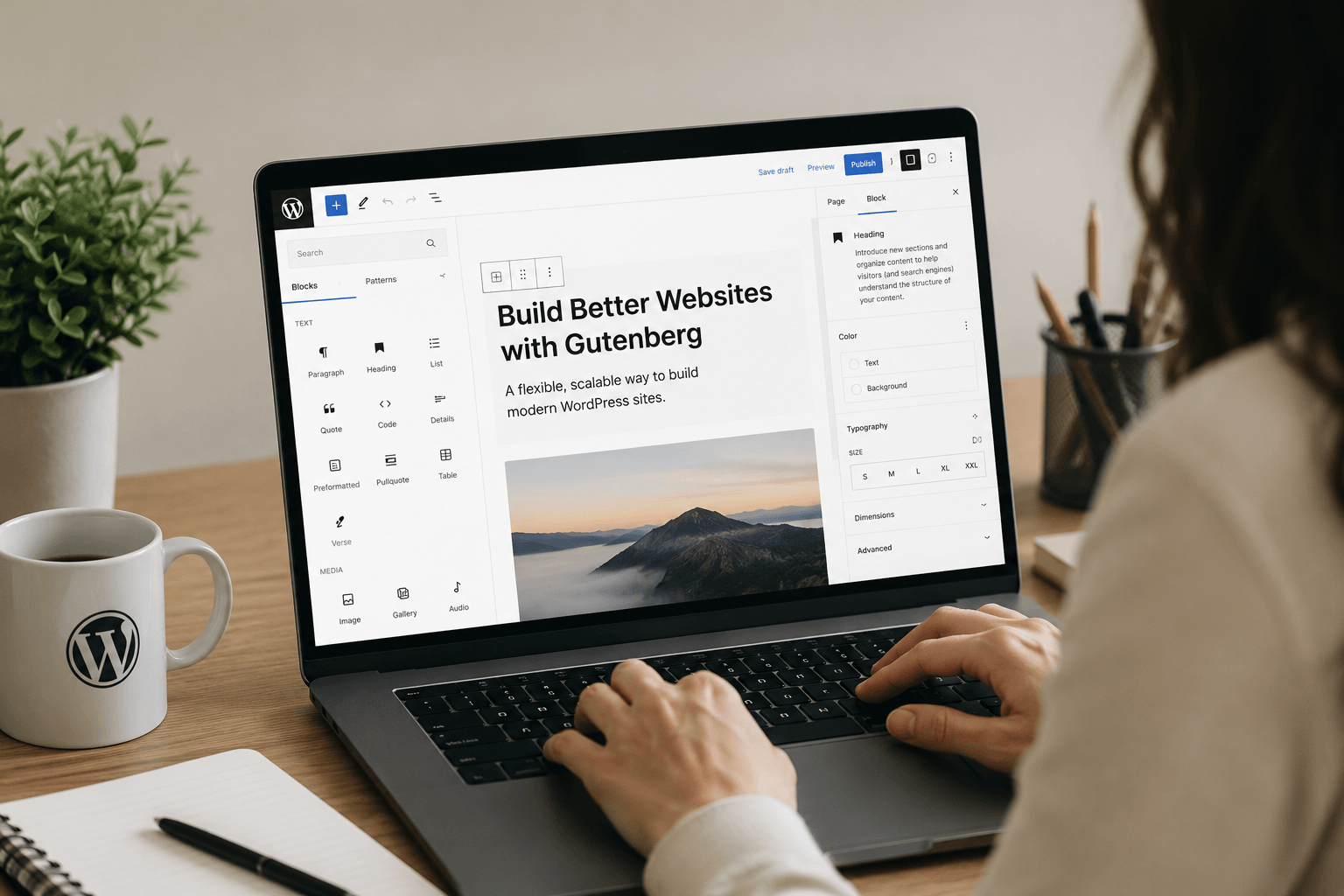
When Gutenberg first came to WordPress, many agencies thought it was just a simple replacement for the old content editor. Gutenberg is no longer an editor. It’s a flexible framework that helps agencies build structured, scalable websites directly in WordPress.
Because of using rigid templates, content is built with blocks that can be reused and arranged in different ways. Clients can make pages using approved blocks without needing custom development every time. The editing experience feels more visual and easier to understand than WordPress.
Clients can:
- Edit content directly.
- Move sections around.
- See how layouts look.
- Manage pages with confidence.
This makes clients less scared of managing content. When clients feel comfortable using their website, they update content more often, which keeps the website effective for longer. Agencies can build custom block systems that fit client needs while keeping the architecture clean.
This creates:
- Website maintenance.
- Better scalability.
- More predictable updates.
- Reduced risks of dependency.
Rather than constantly fighting against external builder limitations, agencies work more closely with the native WordPress ecosystem. While performance still depends on development quality, Gutenberg allows agencies to build systems with more control.
Flexible Doesn’t Mean Losing Control
One reason some agencies are afraid to use Gutenberg is fear.
They think that if they give their clients freedom to make changes, the clients will mess things up.
They worry that clients will:
- Ruin the way things look.
- Make the design inconsistent.
- Use too much or too little space.
- Make it hard for people to use the website.
The truth is that clients can make changes while still maintaining a level of control. The key is creating a system with clear rules that allow clients to customize content without breaking the overall design.
Controlled Design Systems
With Gutenberg, agencies can create reusable patterns and pre-designed page sections that clients can insert and edit easily.
For example:
- The main section is at the top of the page.
- What do other people say about the company?
- Tables that show prices.
- Asked questions.
- Sections that ask people to do something.
- Layouts show what services the company offers.
This speeds up content creation while keeping the design polished and professional.
Block Locking and Permissions
Gutenberg also gives agencies control over what clients can and cannot edit. Important design elements can be locked, allowing clients to update only the sections they need to change. This helps maintain the website’s quality and consistency without making the editing experience difficult for clients.
Building Systems Instead of Pages
Successful agencies are no longer just building pages — they are building systems. When agencies create systems, websites become easier to update, expand, and scale over time because the foundation is flexible and structured. This is where Gutenberg becomes especially powerful for agencies that want long-term relationships with clients. Agencies can build scalable systems that support client growth, and Gutenberg provides the tools to make those systems practical and easy to manage.
Why Agencies Benefit the Most from Gutenberg
Clients benefit from websites, but in the long run, agencies often gain the most from working with structured block systems.
Faster Project Delivery
Using block-based systems means agencies don’t have to rebuild the same development work for every project. Instead of designing new layouts from scratch each time, agencies can reuse proven structures across multiple websites.
Easier Team Scaling
When websites are built with reusable block systems, it becomes much easier to onboard new developers. Teams can rely on a shared architecture and predictable patterns instead of learning a different custom setup for every project. This makes agency workflows more scalable and reduces friction when teams grow or change.
Reduced Maintenance Overhead
Agencies often lose profitability because of ongoing maintenance and small client support requests. When clients are empowered to safely edit their own websites, agencies spend less time on low-value support to work. This reduces maintenance overhead and allows agencies to focus more on higher-value development and system improvements.
This means the teams can focus on the WordPress website and the clients
- Strategy.
- Growth.
- Development that is worth more.
- Long-term partnerships with the client and the WordPress community.
Better Client Relationships
Clients like websites that they can use and edit with the WordPress editor. When clients feel in control, they trust the agency more. It is funny that agencies keep clients longer when they make it, so clients do not need them much for the WordPress website. The WordPress ecosystem is moving towards block-based development with Gutenberg. Starting early gives agencies an advantage over agencies that do not use the WordPress platform and Gutenberg.
The Biggest Mistake Agencies Make with Gutenberg
Some people try out Gutenberg for a while and do not like how it works at first, so they give up on it too quickly. The problem is that people think Gutenberg should work perfectly without any changes. Gutenberg works best when it’s used as a structured starting point that can be customized, rather than as a completely open-ended editor. When Gutenberg is set up properly, it becomes more powerful than traditional workflows. It is easier to use, scales with a project’s needs, and helps maintain strong design consistency, one of its most important advantages.
Conclusion
The hidden cost of a website that is difficult to change goes far beyond technical limitations. It shows up in marketing delays, frustrated clients, inefficient workflows, constant support requests, and ultimately limited growth for agencies. Many businesses do not realize how much time and money are lost when their website cannot adapt quickly to changing needs. For agencies, the long-term impact is even greater. Rigid systems create ongoing friction that reduces profitability and consumes valuable development time that could be focused on higher-value work. The Gutenberg editor in WordPress is not just a tool — it is a way of working built around simple content structures, streamlined workflows, and a more intuitive editing experience.
When used properly, Gutenberg helps agencies to:
- Reduce maintenance effort.
- Speed up development.
- Build reusable content systems.
- And create websites that grow with the businesses they support.
The agencies that will stand out in the coming years are not the ones delivering websites that clients are afraid to change.